
 +86-18378303768
 2026-01-18
The Real Differences Between Classical Pilates & Balanced Body Contemporary
After 15 years of classical practice, you’re deeply familiar with its core tenets: fixed 34-exercise sequences, minimal props, spring tension chosen for muscle control (not “ease”), and cueing focused on feeling muscle engagement (e.g., “pull your belly button to your spine”). Balanced Body contemporary Pilates—rooted in the same foundational principles but adapted for modern rehab and fitness goals—diverges in four critical ways that likely triggered your frustration:
| Feature | Classical Pilates | Balanced Body Contemporary Pilates |
|---|---|---|
| Sequencing | Fixed, non-negotiable 34 exercises (Joseph Pilates’ original order) for each machine. No deviations—progression comes from mastering form, not changing moves. | Flexible, customized sequences tailored to class goals (e.g., core stability, shoulder mobility). Moves are swapped, added, or modified; traditional sequences are rarely followed in full. |
| Cueing Style | Sensory, feeling-based cues (e.g., “lengthen your spine like a string is pulling your head up”). Focuses on connecting mind to muscle. | Literal, instruction-based cues (e.g., “place your feet hip-width on the footbar, press back with your heels, and hold the circle at chest height”). Focuses on movement mechanics over sensory engagement. |
| Equipment & Props | Minimal props—relies on machine springs and body weight. Spring tension is chosen to challenge muscle control (heavier springs for advanced practitioners). | Integrates props (magic circle, resistance bands, stability balls) to add coordination challenges or target specific muscles. Spring tension is often lighter to prioritize form over resistance. |
| Instructor Role | Guides form correction but respects practitioner’s knowledge of their body (e.g., if you prefer heavier springs, they accommodate). | Takes a directive role—adjusts spring tension, footbar position, and moves to align with contemporary teaching protocols, even if it contradicts your preferences. |
Why Your First Balanced Body Class Felt So Frustrating (It’s Not You—It’s the Style Clash)
Your frustration stems from three core conflicts between your classical training and BB contemporary’s approach—all of which are normal for long-time classical practitioners:
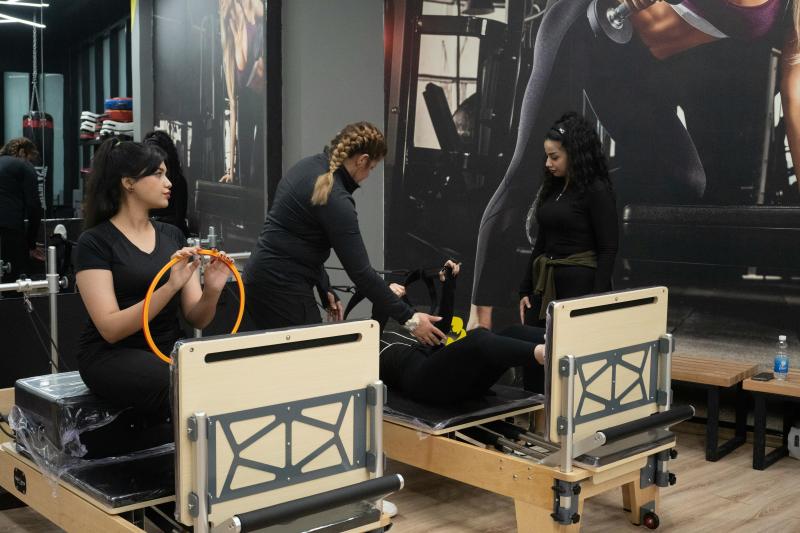
- You’re Used to Controlling Your Practice (Not Following Directions)After 15 years, you know exactly what spring tension works for your body—especially after a break from practice due to IVF. When the instructor reduced your springs, it likely removed the resistance you need to feel muscle engagement (classical relies on that resistance to build strength; contemporary often uses lighter springs to prioritize mobility or coordination). This is why you left feeling “unworked”—the resistance wasn’t matched to your skill level.
- Coordinated Props (Like the Circle) Disrupt Your Core Engagement FocusClassical Pilates trains you to isolate and engage core muscles without distraction. Adding a magic circle introduces a coordination layer that splits your attention—you’re no longer just focusing on core bracing; you’re also worrying about holding the circle, pressing it correctly, and syncing that movement with your reformer work. For a classical practitioner, this feels like a “distraction” from the core work you value—and it’s why your brain struggled to engage the right muscles.
- Literal Cueing Feels “Flat” Compared to Classical’s Sensory CuesClassical instructors use cues that help you feel the movement (e.g., “imagine your ribs are closing like a book”). BB contemporary instructors often use literal, step-by-step instructions (e.g., “bend your elbows 90 degrees, press the circle outward”). For someone who’s spent 15 years tuning into their body’s sensations, this literal style can feel disconnected and unfulfilling—it skips the “mind-body” connection that makes classical Pilates so effective for you.
The Big Myth: Can You Do Classical Pilates on Balanced Body Machines?
The instructor’s claim that “you can’t do classical on BB machines” is mostly marketing, not fact. Here’s the truth:
Balanced Body reformers (and other equipment) are mechanically similar to traditional classical reformers. The core components—carriage, springs, footbar, straps—function the same way. The difference is often in aesthetics (wood vs. metal frames) or minor adjustments (e.g., adjustable footbar heights), which don’t prevent you from doing classical sequences.
The real barrier is studio policy, not equipment. Many BB-trained studios prioritize contemporary programming and discourage classical sequences because their instructors are trained in contemporary methods—not because the machines can’t handle it.
If the studio is close to home and you want to use it, you can ask for a private session where you lead the classical sequence—many instructors will accommodate this (especially if you explain your 15 years of experience and IVF-related need for familiar, controlled movement).
 Back to list


 +86-18378303768